Most manual work in logistics is not hard. It is repetitive, and it sits between systems. A booking arrives by email. Someone opens it, copies the details, checks rates in a few places, retypes everything into the TMS and replies. Then the same person does it again, dozens of times a day.
AI agents are built for exactly this kind of work. The question for a logistics enterprise is no longer whether an agent can read an email. It is which manual steps to hand over first, and how to do it without losing visibility or control.
Where the manual work hides
Look at any desk in a forwarder, carrier or 3PL and the same patterns appear:
- Reading and retyping. Orders, bookings, rate sheets and invoices arrive as emails, PDFs and spreadsheets, and people key them into the TMS, ERP or CRM.
- Looking things up. Checking rates, schedules, shipment status or customer history across several systems to answer one question.
- Chasing. Following up on missing documents, unanswered quotes, unconfirmed bookings and overdue payments.
- Routing. Deciding who in the team should handle each inbound message.
- Reporting. Pulling numbers together to explain what already happened.
None of these steps needs a person's judgment most of the time. All of them take a person's time.
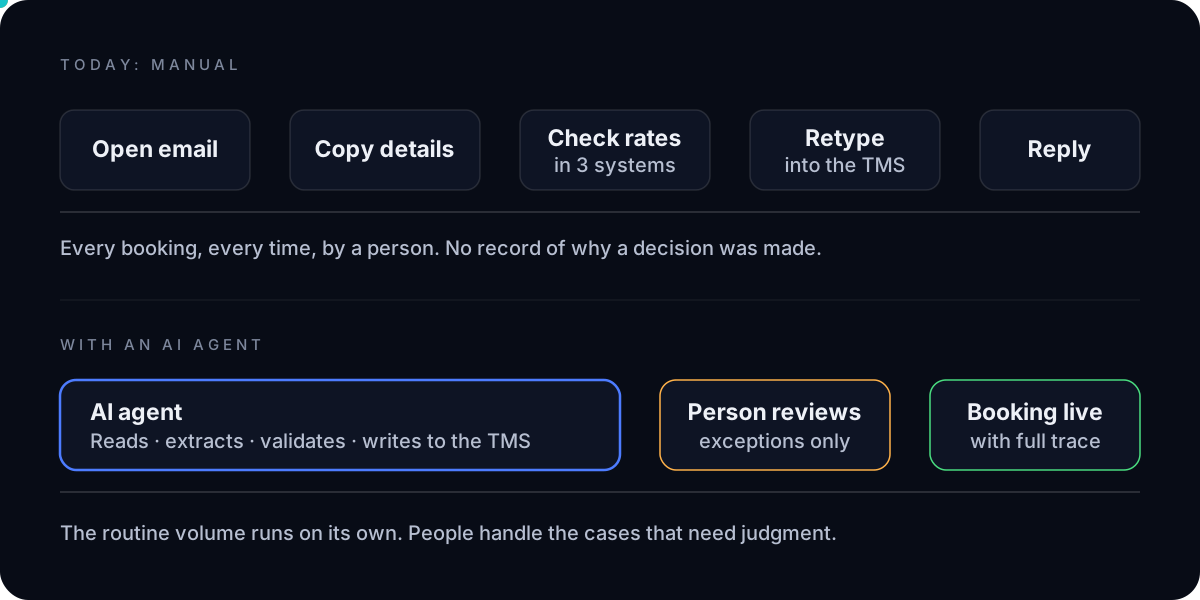
What an AI agent does instead
An AI agent takes a job from start to finish rather than helping with one keystroke. For a booking, that means:
- Read the email and attachments, whatever their format.
- Extract the shipper, consignee, lane, equipment, dates and references.
- Validate them against the customer record, rates and business rules.
- Act: create or update the shipment file in the TMS and reply in the same thread.
- Escalate anything incomplete or unusual to the right person, with the context attached.
The same pattern covers quoting, track and trace updates, document collection, inbox triage and collections. Exworks maintains more than 40 certified workflows of this kind, adapted to each company's systems and rules.
The four outcomes that matter
Replacing manual steps is the means. The outcomes a logistics enterprise should hold AI agents to are these:
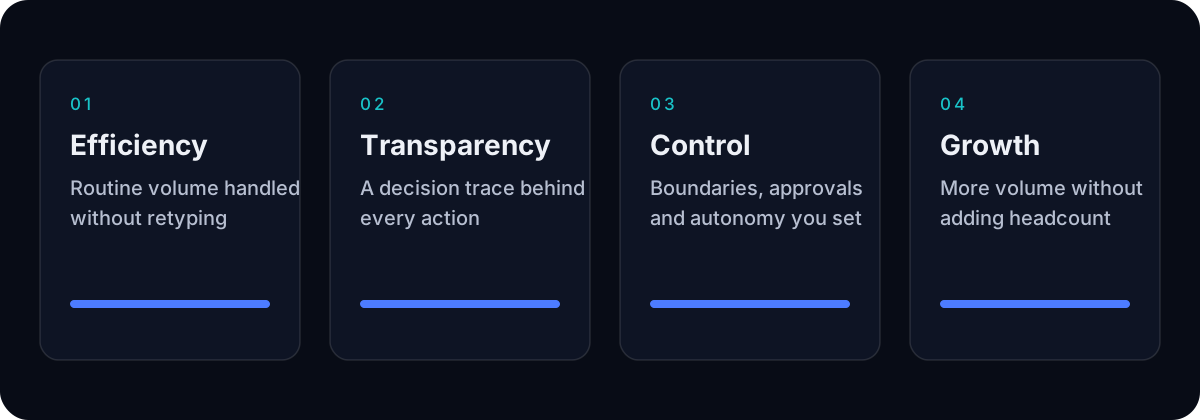
Efficiency
Routine volume is handled without retyping, so response times drop and people spend their day on customers and exceptions. Requests that used to wait in a shared inbox overnight get answered.
Transparency
Manual work leaves little record of why something was done. An AI agent should record every decision: what it read, what it checked, its confidence and what it did. Any figure on a dashboard can then be traced back to the actions behind it, which also makes audits simpler.
Control
Agents should never be a black box acting on their own authority. Boundaries such as margin floors, mandatory review for dangerous goods, or systems an agent may read but not change are enforced at the connector, not left to a prompt. Each workflow runs in the mode you choose: supervised, ramping or autonomous. An agent earns more autonomy only on evaluation evidence.
Growth
When routine work scales with software rather than headcount, the business can take on more shipments, customers and lanes without adding people at the same pace. Teams grow into higher-value roles instead of more data entry.
How to start replacing manual work
- Map one process end to end. Pick a high-volume job such as booking intake, RFQ response or status updates, and write down every manual step.
- Choose the steps with the least judgment. Reading, retyping, looking up and chasing usually come first.
- Connect the real systems. An agent that cannot write to the TMS or reply in the thread will stay a demo.
- Run supervised, then promote. Every action is reviewed at first. Autonomy grows as accuracy is proven.
- Measure outcomes, not activity. Track response time, corrections, hours returned and exceptions, on one scoreboard shared by operations and IT.
With Exworks, the first AI agent workflow is typically in production within 45 days, deployed by Exworks engineers alongside your team on top of the systems you already run.