Most logistics enterprises are no longer asking whether to use AI agents. They already have them, often more than they can count. The pricing team runs a quoting agent from one vendor. Operations built its own order-entry agent. Customer service uses assistant licenses. Finance has RPA bots chasing payments.
Each of these may work on its own. Together, they create a new problem.
The real problem: AI without a center
In a large logistics company, AI tends to grow in pockets:
- Departments build AI agents independently, each with its own tools, rules and owners.
- Different vendors supply different solutions, each with its own settings, reports and contract.
- There is no central place to manage, monitor and control what all these agents are doing.
- The business value of each agent is hard to measure, so it is unclear which ones to scale and which to stop.
The result is predictable. Leadership cannot see the whole picture, IT cannot approve more agents with confidence, and AI stays stuck in pilots. This is exactly the gap Exworks is built to close.
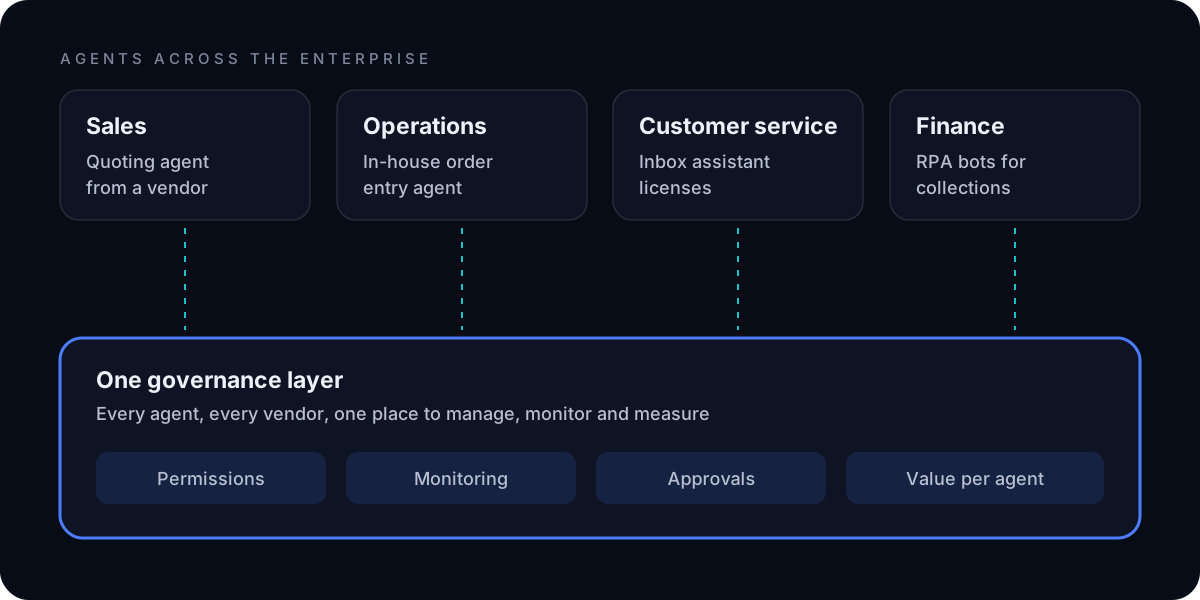
Governance is what makes enterprise-wide AI possible
Governance is often treated as a security and compliance checkbox. In practice, it does something more valuable: it is what allows a company to expand its use of AI safely.
When every agent sits in one governance layer, the business can answer the questions that decide whether AI grows:
- What is each agent allowed to do, and who owns it?
- What did it do, and with what result?
- What value did it deliver in hours saved, revenue protected or faster response, and what did it cost?
- Is it safe to give it more work?
With those answers, scaling AI becomes a business decision based on evidence rather than a leap of faith.
A real example: 1,000 price requests a day
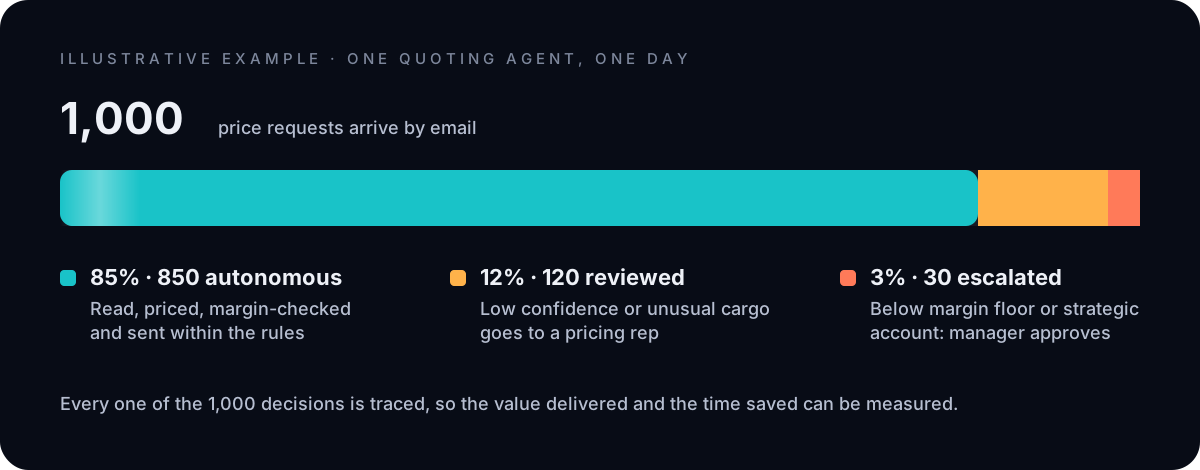
Take a quoting agent at a forwarder that receives 1,000 price requests a day. With governance in place, its day might look like this:
| Share | Requests | What happens |
|---|---|---|
| 85% | 850 | Handled autonomously: read, priced, margin-checked and sent within the rules |
| 12% | 120 | Sent to a pricing rep for review: low confidence or unusual cargo |
| 3% | 30 | Escalated for manager approval: below the margin floor or a strategic account |
An illustrative example; the split depends on each company's rules and lanes.
The value is not only that 850 quotes went out without anyone typing them. It is that every one of the 1,000 decisions is visible: the business knows how much work the agent took on, where people stepped in and why, and can decide with confidence whether to extend it to more lanes or customers.
The controls that make this work
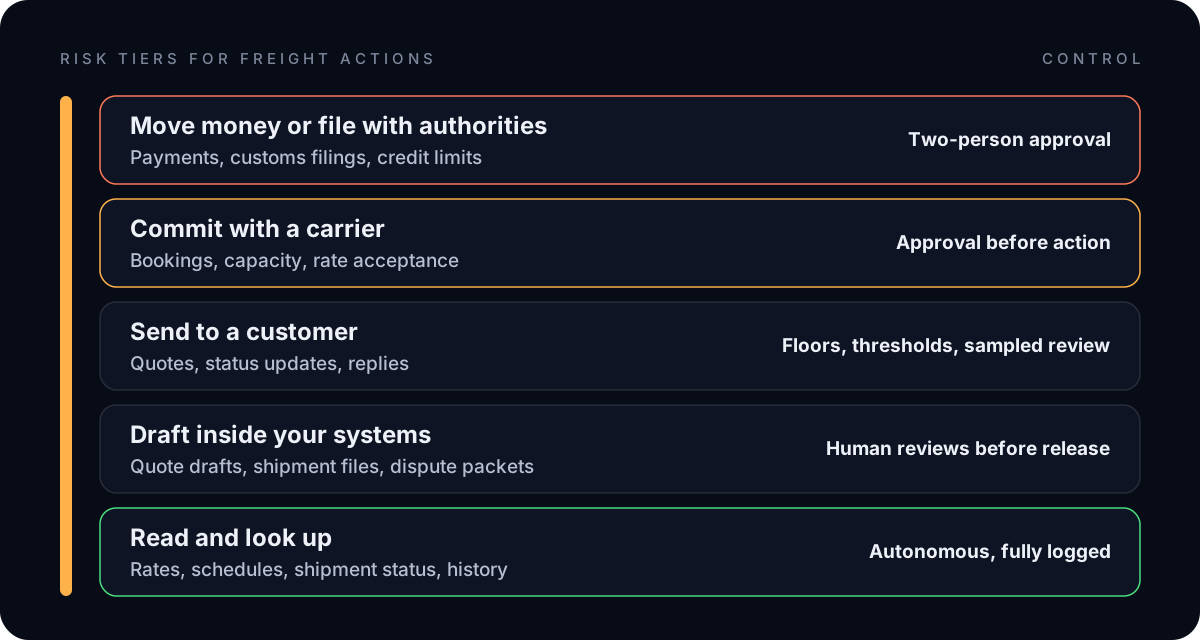
Match the control to the risk of the action
The riskier the action, the tighter the control. Reading data can run on its own; committing money cannot.
Enforce boundaries where the agent acts
Margin floors, permissions and mandatory reviews belong in the systems the agent works through, not only in its instructions. A boundary enforced at the connector holds even when a model misreads a request.
Earn autonomy on evidence
New workflows start supervised, with every action reviewed. They move to more autonomy only when evaluation results show they meet their quality bar, and they can be moved back at any time.
Keep a trace for every decision
Every AI step records what it read, what it decided, how confident it was and what it did. That trace serves audits, explains any number on a dashboard and turns human corrections into reviewed rules.
Where to start
- Map every AI agent in the company, by department and vendor, with its owner and purpose.
- Bring them into one view with shared permissions, monitoring and approvals.
- Define the value each agent should deliver and measure it on one scoreboard.
- Place every action in a risk tier and enforce the matching control.
- Scale what works, based on evidence.
Exworks provides this layer for logistics enterprises: one place to build, run, monitor and govern every AI agent and workflow, with guardrails enforced at the connector, supervised, ramping or autonomous mode per workflow, a decision trace on every step and one control tower for the whole AI workforce. It runs on AWS in Europe and is SOC 2 and ISO 27001 certified.